
The D.El.Ed Entrance Exam 2026 is one of the most sought-after teacher training entrance tests in India. If you aspire to become a primary school teacher and shape young minds, clearing this exam is your first and most critical step. This comprehensive guide covers the D.El.Ed 2026 syllabus, exam pattern, subject-wise marks distribution, eligibility conditions, and preparation strategies — everything you need in one place.
What is D.El.Ed? Why Does It Matter In 2026?
D.El.Ed(Diploma in Elementary Education), is a two-year professional teacher training program mandated by the National Council For Teacher Education(NCTE).It qualifies candidates to teach students in primary classes across government and private schools in India.
With the Right to Education(RTE)Act making trained teachers mandatory in every elementary school, demand for D.El.Ed qualified teachers has skyrocketed. Completing this course also makes candidates eligible to appear for CTET(Central Teacher Eligibility Test) and various state level TETs, opening the door to government teaching jobs with long term job security and social impact.
D.El.Ed Entrance Exam 2026:Exam Pattern At Glance
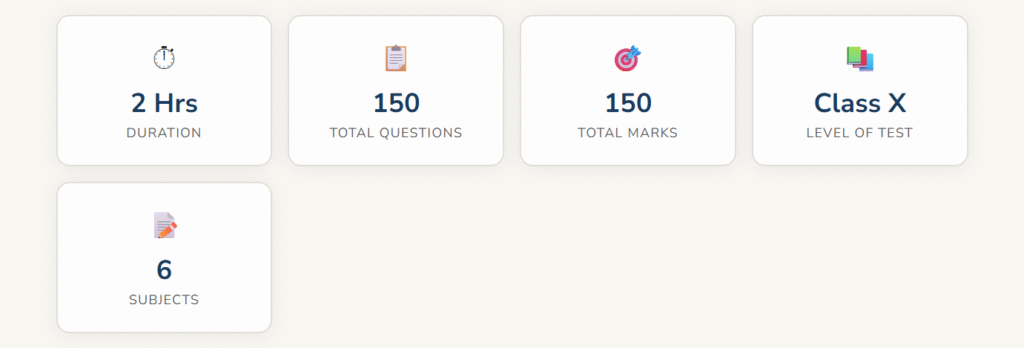
The D.El.Ed Entrance Exam 2026 follows a straightforward, objective-type format. Here are the key details every aspirant must memorize before sitting down to prepare:
- Mode of Exam: Offline (Pen & Paper)
- Type of Questions: Multiple Choice Questions (MCQs)
- Total Duration: 02 Hours (120 minutes)
- Total Questions: 150
- Total Marks: 150 (1 mark per question)
- Negative Marking: Check official notification (https://scertdelhi.admissions.nic.in/)
- Standard of Questions: Class X (10th grade) level
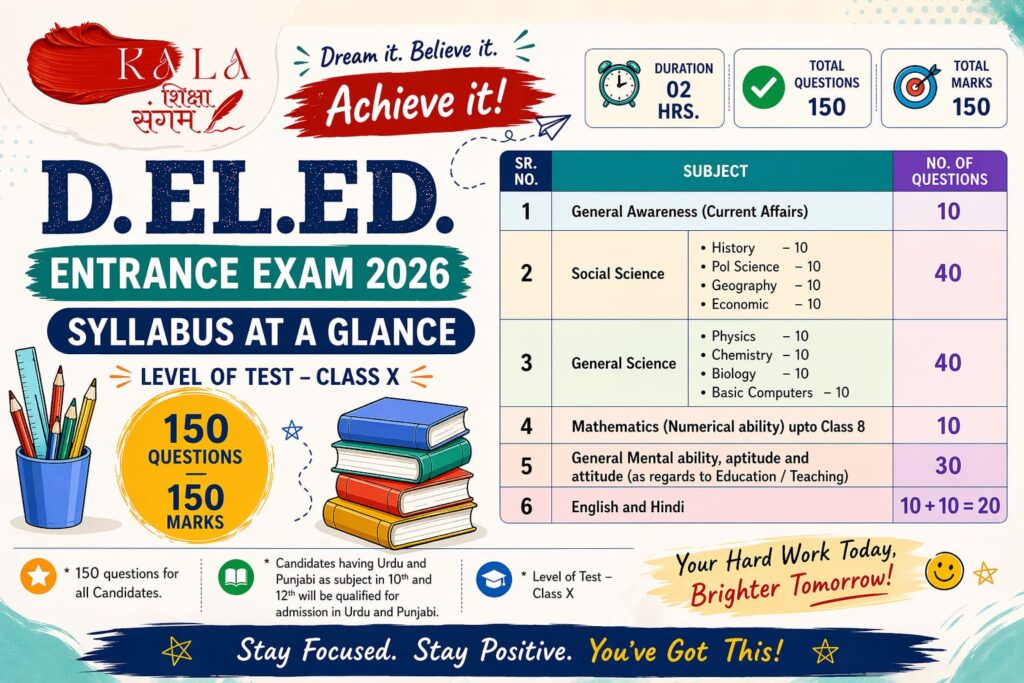
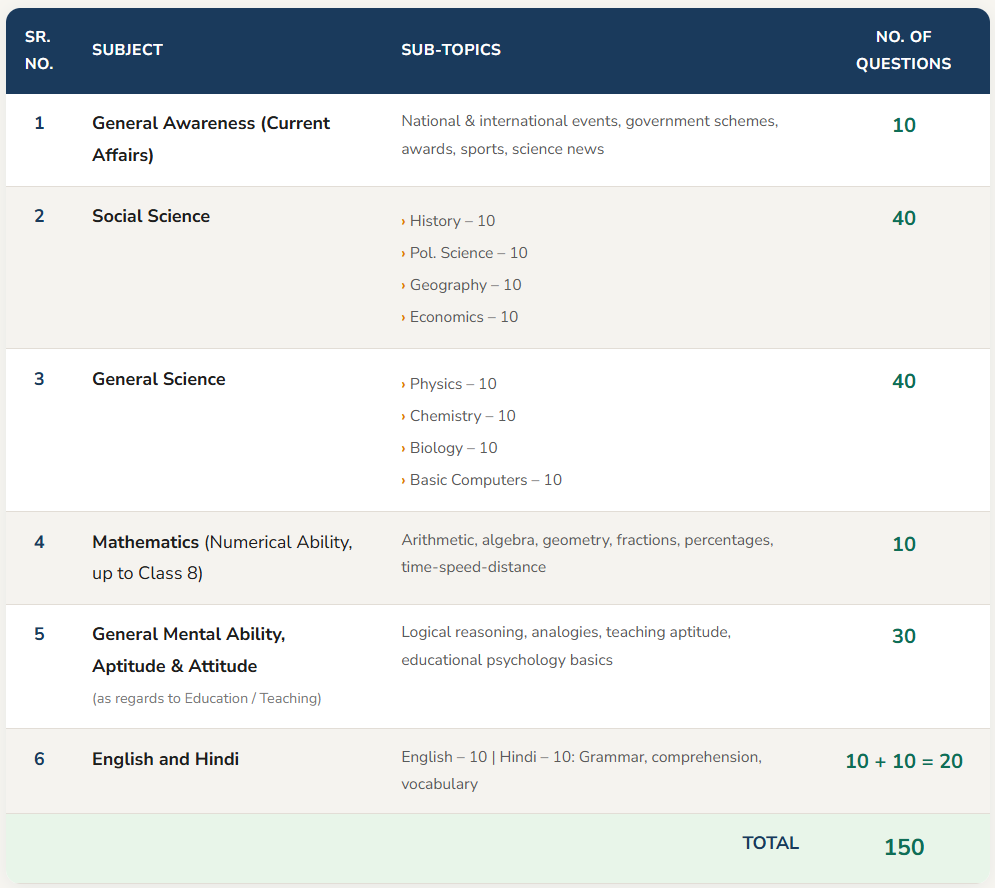
D.El.Ed 2026 Syllabus — Subject-Wise Question Distribution
Subject-Wise Analysis & What to Focus On
1. Social Science (40 Questions) — Highest Weightage
With 40 questions, Social Science is the highest-scoring section of the D.El.Ed 2026 entrance exam. It is divided evenly across four disciplines — History, Political Science, Geography, and Economics (10 questions each). Candidates must focus on NCERT textbooks from Classes 6 to 10. Topics like India’s freedom struggle, Indian Constitution, physical geography of India, and basic economic concepts carry recurring importance.
2. General Science (40 Questions) — Equal Highest Weightage
Tied with Social Science at 40 questions, General Science covers Physics, Chemistry, Biology (10 each), and — importantly — Basic Computers (10 questions). Many students ignore the computer section, but it is an easy scoring opportunity. Topics like hardware/software basics, MS Office, internet, and digital literacy are commonly asked. Physics, Chemistry, and Biology questions are predominantly from Class 8–10 NCERT level.
3. General Mental Ability, Aptitude & Attitude (30 Questions)
This section is often underestimated but carries a significant 30 marks. It evaluates reasoning ability, teaching aptitude, and attitude towards education. Questions test logical reasoning, series completion, analogies, classification, and basic educational scenarios. Regular practice through reasoning workbooks and mock tests is the key to scoring well here.
4. English and Hindi (20 Questions)
Languages account for 20 marks combined (10 each). English questions typically cover grammar rules, fill-in-the-blanks, vocabulary, and one-word substitution. Hindi questions test व्याकरण (grammar), मुहावरे (idioms), and reading comprehension. Both sections are scoring if practiced with previous year papers.
5. Mathematics — Numerical Ability up to Class 8 (10 Questions)
Mathematics has the lowest question count but can make or break your rank if you’re competing closely. The syllabus is limited to Class 8 level — covering basic arithmetic, ratios, percentages, simple equations, and mensuration. Daily practice of 5–10 numerical questions can ensure a perfect 10/10 in this section.
6. General Awareness — Current Affairs (10 Questions)
This dynamic section requires candidates to stay updated with national and international events up to the month of the exam. Reading a daily newspaper, watching news, or following a current affairs app for 3–6 months before the exam is sufficient to score all 10 marks.
Top 7 Tips to Score High in D.El.Ed Entrance Exam 2026
- Create a timetable — Divide your daily study time across all 6 subjects proportionally to their marks weightage.
- Master the high-weightage sections first — Social Science and General Science together carry 80 out of 150 marks. Prioritize them.
- Don’t ignore Computers — Basic computer literacy (10 marks) is one of the most ignored yet easily scored sections.
- Solve previous year papers — At least 5 full-length previous year papers should be attempted in the last 30 days.
- Time yourself — With 150 questions in 120 minutes, you get just 48 seconds per question. Regular timed practice is essential.
- Stay updated on current affairs — Begin 6 months before the exam. Use apps, newspapers, or monthly GK digests.
- Take care of health — Sleep adequately, eat well, and avoid exam anxiety. Consistency beats cramming every time.
Frequently Asked Questions(FAQ)
Q1. What is the full form of D.El.Ed?
D.El.Ed stands for Diploma in Elementary Education. It is a two-year teacher training program that qualifies candidates to teach Classes 1–8.
Q2. What is the syllabus level for D.El.Ed Entrance Exam 2026?
The level of the test is Class X (10th standard). Questions are based on NCERT curriculum up to the 10th grade.
Q3. How many questions are there in the D.El.Ed 2026 entrance exam?
There are 150 questions for all candidates, each carrying 1 mark, making the total 150 marks.
Q4. What is the duration of the D.El.Ed 2026 exam?
The exam duration is 2 hours (120 minutes).
Q5. Which subject has the maximum questions in D.El.Ed 2026?
Both Social Science and General Science have the maximum weightage with 40 questions each (80 questions combined out of 150).
Q6. Are Urdu and Punjabi medium students eligible for D.El.Ed 2026?
Yes. Candidates who have studied Urdu or Punjabi as a subject in 10th and 12th standard will be qualified for admission in the Urdu and Punjabi medium programs respectively.
Q7. After D.El.Ed, which exams can I appear for?
After completing D.El.Ed, candidates become eligible to appear for CTET (Central Teacher Eligibility Test), state-level TET exams, and various government primary teacher recruitment drives.
Conclusion
The D.El.Ed Entrance Exam 2026 is a well-structured, fair, and nationally recognized gateway to a fulfilling career in teaching. With 150 questions spread across 6 subjects at the Class X level, any sincere and focused aspirant can clear the exam with 3–6 months of consistent preparation.
Remember: Social Science and General Science carry 80 marks combined — master these first. Build your reasoning skills for the 30-mark aptitude section, and never neglect Basic Computers. Pair your preparation with daily current affairs reading, and you will be well on your way to securing your seat in the D.El.Ed program.
Dream it. Believe it. Achieve it. — Your hard work today truly leads to a brighter tomorrow in the teaching profession.